
In This Article
MCV4U is the single most critical high school mathematics prerequisite for competitive university STEM programs across Canada, including University of Waterloo (Engineering, Computer Science, Math), University of Toronto (Engineering, Rotman Commerce), and McMaster University. This exam review provides essential formula reference sheets, step-by-step differentiation techniques, and full worked exam practice problems.
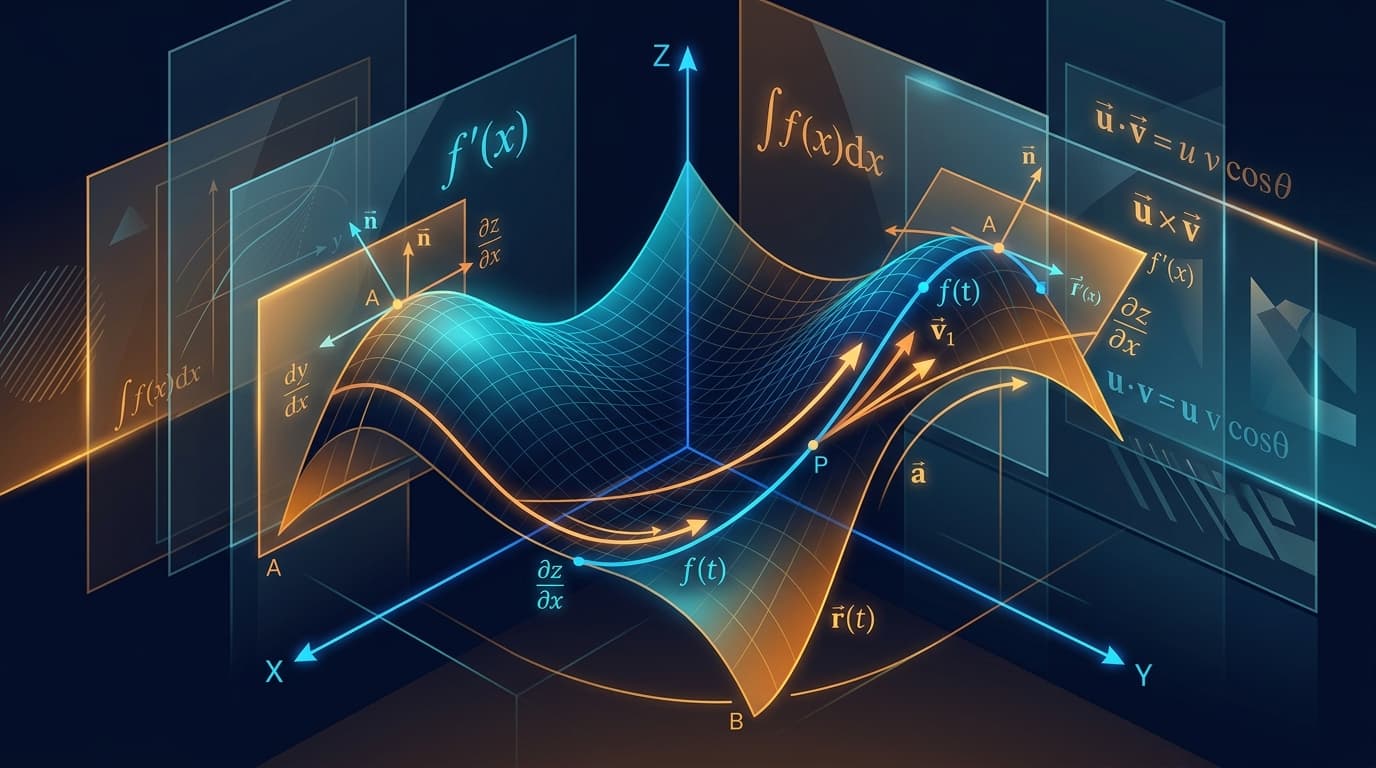
The Official MCV4U Differentiation & Vectors Formula Sheet
- Fundamental Differentiation Rules: Power Rule: d/dx(x^n) = n·x^(n-1); Product Rule: d/dx[f(x)·g(x)] = f'(x)·g(x) + f(x)·g'(x); Quotient Rule: d/dx[f(x)/g(x)] = [f'(x)·g(x) - f(x)·g'(x)] / [g(x)]^2; Chain Rule: d/dx[f(g(x))] = f'(g(x))·g'(x).
- Exponential & Logarithmic Derivatives: d/dx(e^x) = e^x; d/dx(e^(g(x))) = e^(g(x))·g'(x); d/dx(a^x) = a^x · ln(a); d/dx(ln(x)) = 1/x; d/dx(ln(g(x))) = g'(x) / g(x).
- Sinusoidal Derivatives: d/dx(sin x) = cos x; d/dx(cos x) = -sin x; d/dx(tan x) = sec^2(x); Chain forms: d/dx(sin(kx)) = k·cos(kx).
- Geometric Vectors: Magnitude |v|; Dot Product: u · v = |u||v|cos(θ); Cross Product: |u × v| = |u||v|sin(θ); Work done W = F · d = |F||d|cos(θ); Torque τ = r × F.
- Algebraic 3D Vectors: Let u = (u₁, u₂, u₃) and v = (v₁, v₂, v₃). Dot product: u · v = u₁v₁ + u₂v₂ + u₃v₃. Two non-zero vectors are perpendicular if and only if u · v = 0.
- Cross Product in R³: u × v = (u₂v₃ - u₃v₂, u₃v₁ - u₁v₃, u₁v₂ - u₂v₁). The cross product vector is mutually perpendicular to both u and v.
- Lines & Planes in R³: Vector line: r = r₀ + t·m; Parametric line: x = x₀ + t·m₁, y = y₀ + t·m₂, z = z₀ + t·m₃; Scalar equation of plane: Ax + By + Cz + D = 0 where normal vector n = (A, B, C).
Unit 1: Derivative Calculation Practice
Practice Question 1 (Algebraic Differentiation): Determine the derivative f'(x) for f(x) = (3x² - 5x)⁴ · e^(2x) and evaluate f'(0).
Worked Solution 1:
- Apply the Product Rule: Let u(x) = (3x² - 5x)⁴ and v(x) = e^(2x). Then f'(x) = u'(x)·v(x) + u(x)·v'(x).
- Differentiate u(x) using the Chain Rule: u'(x) = 4(3x² - 5x)³ · (6x - 5).
- Differentiate v(x) using the Chain Rule: v'(x) = 2·e^(2x).
- Assemble f'(x): f'(x) = 4(6x - 5)(3x² - 5x)³ · e^(2x) + 2(3x² - 5x)⁴ · e^(2x).
- Factor the expression: f'(x) = 2(3x² - 5x)³ · e^(2x) · [2(6x - 5) + (3x² - 5x)] = 2(3x² - 5x)³ · e^(2x) · [3x² + 7x - 10].
- Evaluate at x = 0: When x = 0, the term (3(0)² - 5(0))³ = 0, therefore f'(0) = 0.
Unit 2: Optimization in Applied Contexts
Practice Question 2 (Optimization): A manufacturing firm in Oakville designs a closed cylindrical can with fixed volume V = 500 cm³. The material for the top and bottom circular disks costs $0.06/cm², while the material for the side costs $0.04/cm². Determine the radius r and height h that minimize total production cost.
Worked Solution 2:
- Volume Constraint: V = π·r²·h = 500 ⇒ h = 500 / (π·r²).
- Cost Function C(r): C = Cost_ends + Cost_side = 2·(π·r²)·(0.06) + (2·π·r·h)·(0.04) = 0.12·π·r² + 0.08·π·r·h.
- Substitute h: C(r) = 0.12·π·r² + 0.08·π·r·[500 / (π·r²)] = 0.12·π·r² + 40/r = 0.12·π·r² + 40·r^(-1).
- Find critical points by setting C'(r) = 0: C'(r) = 0.24·π·r - 40·r^(-2) = 0 ⇒ 0.24·π·r = 40 / r².
- Solve for r: r³ = 40 / (0.24·π) = 40 / 0.75398 = 53.0516 ⇒ r = (53.0516)^(1/3) ≈ 3.76 cm.
- Calculate optimal height: h = 500 / (π · (3.76)²) = 500 / (44.41) ≈ 11.26 cm.
- Verify minimum with Second Derivative Test: C''(r) = 0.24·π + 80/r³ > 0 for all r > 0, confirming a local and absolute minimum cost at r ≈ 3.76 cm and h ≈ 11.26 cm.
Unit 3: 3D Vectors & Line-Plane Intersections
Practice Question 3 (Vectors in 3-Space): Find the point of intersection between the line with parametric equations x = 2 - t, y = 1 + 3t, z = 4 - 2t and the plane 2x - 3y + z - 9 = 0.
Worked Solution 3:
- Substitute the parametric line equations into the scalar plane equation: 2(2 - t) - 3(1 + 3t) + (4 - 2t) - 9 = 0.
- Expand and collect like terms: (4 - 2t) - (3 + 9t) + (4 - 2t) - 9 = 0 ⇒ (4 - 3 + 4 - 9) + (-2t - 9t - 2t) = 0.
- Simplify: -4 - 13t = 0 ⇒ -13t = 4 ⇒ t = -4/13.
- Calculate coordinates using parameter t = -4/13: x = 2 - (-4/13) = 30/13 ≈ 2.31; y = 1 + 3(-4/13) = 1/13 ≈ 0.08; z = 4 - 2(-4/13) = 60/13 ≈ 4.62.
- Concluding Statement: The line intersects the plane at the point P(30/13, 1/13, 60/13).
University Admissions Impact: Why MCV4U Sets Your Admission Average
For admission into Waterloo Engineering or U of T Computer Science, applicants typically present Grade 12 Calculus marks exceeding 92% to 96%. Because MCV4U concepts build rapidly, falling behind in the early derivative units directly jeopardizes midterm marks transmitted to the Ontario Universities' Application Centre (OUAC).
Master MCV4U with Personalized 1-on-1 Mentorship
Book a complimentary 60-minute diagnostic session with an Ontario STEM specialist. We break down derivative rules, optimize test-taking speed, and ensure competitive university admission marks.
Book Your Free Calculus Assessment