In This Article
What Is MCV4U Calculus and Vectors?
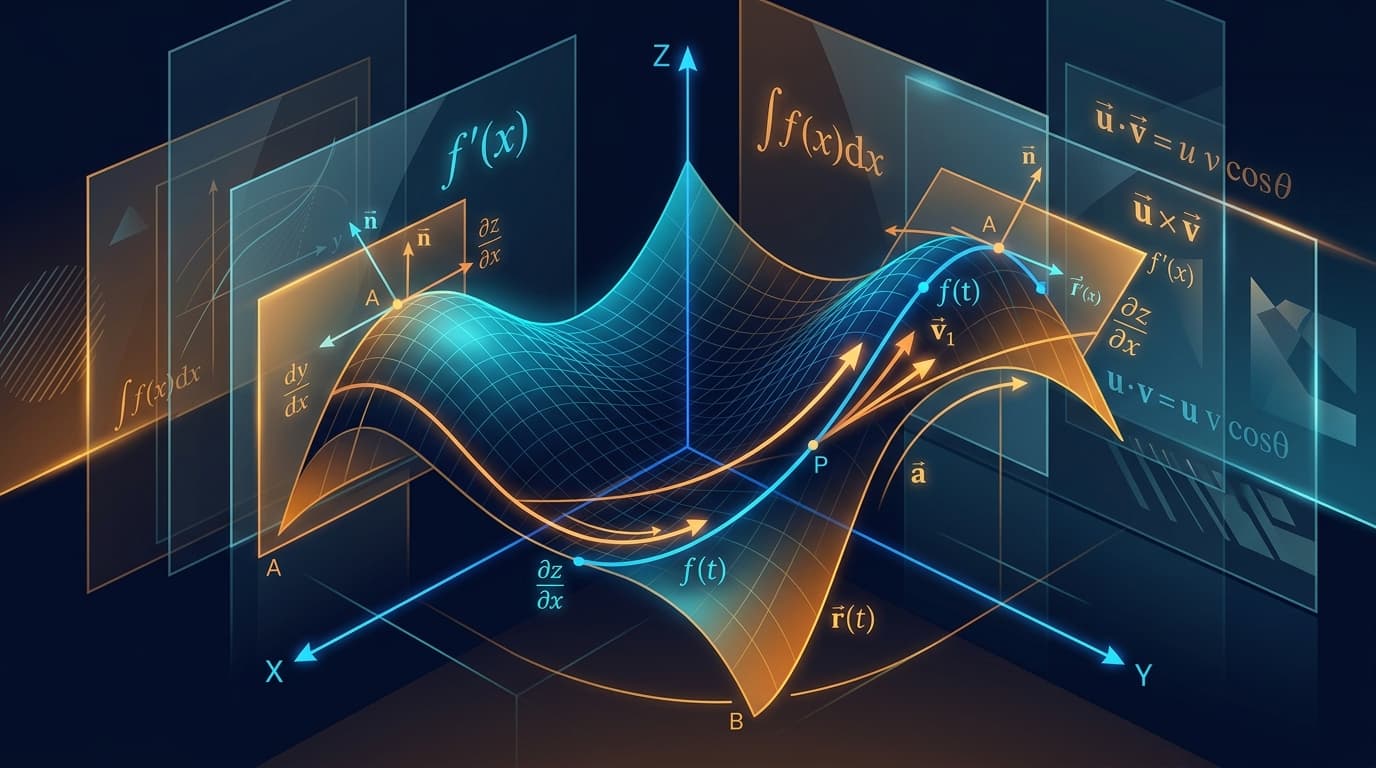
MCV4U is the Grade 12 University Preparation Calculus and Vectors course in the Ontario Curriculum. It is one of the most important math courses for students planning to pursue engineering, science, computer science, or any program requiring mathematical analysis at university. MCV4U introduces students to the concepts of limits, derivatives, integrals, and three-dimensional geometry.
For Burlington students, MCV4U is a gateway course. Engineering programs at Ontario universities require both MCV4U and MHF4U. Science programs in physics, chemistry, and computer science often recommend or require MCV4U. Students who perform well in MCV4U are well-prepared for first-year university calculus.
MCV4U Curriculum Overview
The Ontario Curriculum for MCV4U is organized into two main components: calculus and vectors. The calculus component covers rates of change, limits, derivatives, and applications of derivatives. The vectors component covers vector operations, lines and planes in three-dimensional space, and applications of vectors.
Key Topics in MCV4U: Calculus
The calculus portion of MCV4U begins with the concept of a rate of change and the definition of a derivative. Students learn to determine derivatives of polynomial, rational, exponential, and trigonometric functions using various techniques including the power rule, product rule, quotient rule, and chain rule. Applications include curve sketching, optimization problems, and related rates.
- Rates of change and the definition of the derivative
- Derivatives of polynomial, rational, exponential, and trigonometric functions
- Derivative rules: power, product, quotient, and chain rule
- Curve sketching using first and second derivatives
- Optimization problems -- finding maximum and minimum values
- Related rates -- problems involving changing quantities
Key Topics in MCV4U: Vectors
The vectors portion of MCV4U introduces students to three-dimensional geometry. Students learn vector addition, scalar multiplication, and dot and cross products. They explore lines and planes in 3D space, determine intersections, and solve geometric problems using vectors. Vectors have applications in physics, engineering, and computer graphics.
- Vector representation in 2D and 3D space
- Vector operations: addition, subtraction, scalar multiplication
- Dot product and cross product
- Equations of lines and planes in 3D
- Intersections of lines and planes
- Applications of vectors in geometry and physics
Prerequisites for MCV4U
MCV4U requires MHF4U as a prerequisite. This means students must complete Advanced Functions before taking Calculus and Vectors. The prerequisite exists because MCV4U assumes a strong understanding of function types, transformations, and algebraic manipulation -- all covered in MHF4U. Some schools allow students to take MHF4U and MCV4U concurrently in their final semester, but this is not recommended for most students.
The Relationship Between MHF4U and MCV4U
MHF4U and MCV4U complement each other perfectly. MHF4U builds the function foundation that MCV4U applies to calculus. Understanding polynomial and rational functions from MHF4U makes the derivative rules in MCV4U more intuitive. The trigonometric functions studied in MHF4U are directly applied in calculus problems. Students who take both courses develop a comprehensive understanding of mathematical analysis that prepares them well for university.
Common Challenges in MCV4U
MCV4U presents several challenges for Grade 12 students. The calculus concepts are more abstract than anything students have encountered in previous math courses. The chain rule, in particular, challenges many students because it requires recognizing nested functions and applying multiple rules in sequence. Vector geometry requires spatial reasoning that some students find difficult. The pace of the course means students must stay current -- falling behind in MCV4U is difficult to recover from.
How to Prepare for MCV4U
Strong preparation in MHF4U is the best foundation for MCV4U success. Students should focus on understanding function transformations, polynomial and rational function behavior, and trigonometric identities before starting MCV4U. Over the summer before Grade 12, reviewing MHF4U concepts and previewing basic calculus ideas helps students hit the ground running in September.
MCV4U and University Pathways
MCV4U is a prerequisite or strong recommendation for many Ontario university programs. Engineering programs require both MHF4U and MCV4U. Computer science, physics, chemistry, and mathematics programs require or recommend MCV4U. Business and economics programs may recommend MCV4U for their more quantitative streams. Students who do not take MCV4U significantly limit their options in STEM fields.
How Tutoring Supports MCV4U Success
Calculus and vectors require a different way of thinking than previous math courses. Many students need help developing this new mathematical intuition. A tutor provides step-by-step guidance through derivative rules, helps students visualize vector geometry, and provides practice problems that build problem-solving fluency. One-on-one tutoring is particularly valuable for MCV4U because the concepts build rapidly, and students cannot afford to fall behind.
IntelliX Educational Services provides MCV4U tutoring in Burlington and the Halton region. Our Ontario-certified tutors have strong backgrounds in calculus and vectors and can help students build both conceptual understanding and problem-solving skills. Book a Free Assessment to discuss how tutoring can support your child's MCV4U success.