
In This Article
When an Ontario student starts finding math challenging, parents often search for nearby Kumon learning centers or private tutors. With centers across Burlington, Oakville, Mississauga, and the GTA, Kumon is a familiar household name. However, Kumon's self-study worksheet methodology differs fundamentally from customized 1-on-1 tutoring. Understanding these differences helps families avoid costly frustration, especially as students transition into senior high school courses.
The Kumon Method: Repetition and Speed-Based Progression
Founded in 1958, the Kumon method is centered on self-directed worksheet completion. Students typically attend a center twice weekly and complete daily 15-to-20-minute paper packets at home. Advancement is dictated strictly by speed and perfect accuracy on procedural drills. A student cannot progress to algebraic equations until they master fractions through hundreds of repetitive practice problems.
While this approach builds mental math stamina and calculation speed in elementary grades (Grades 1 to 6), it provides minimal conceptual instruction. When a student makes repeated errors, they are instructed to re-attempt the worksheet until correct, rather than receiving an interactive Socratic explanation of why the underlying mathematical logic functions as it does.
Why Kumon Struggles with Ontario Grades 9 to 12 Math
The Ontario Ministry of Education mathematics curriculum assesses students across four distinct Achievement Chart categories: Knowledge & Understanding, Thinking & Problem Solving, Communication, and Application. Classroom tests rarely consist of isolated computation drills. Instead, students face complex multi-strand questions:
- MTH1W (Grade 9 De-streamed): Integrates algebraic modeling with coding literacy, geometric optimization, and financial decision-making.
- MPM2D (Grade 10 Principles of Math): Requires geometric proofs, quadratic transformations, and applying linear systems to real-world rate problems.
- MCR3U (Grade 11 Functions): Focuses heavily on trigonometric identities, function domain/range mapping, and exponential modeling where rote pattern matching fails.
- MHF4U & MCV4U (Grade 12 Advanced Functions & Calculus): Demands university-level deductive reasoning, instantaneous rate-of-change proofs, and 3D vector geometry.
Kumon does not assist with assigned high school homework, teacher chapter reviews, or classroom culminating projects. A student preparing for a Friday unit test on quadratic relations will receive no assistance on that test if their Kumon packet is currently reviewing linear factorization.
Feature Comparison: Kumon vs. IntelliX 1-on-1 Tutoring
| Feature | Kumon Learning Centers | IntelliX 1-on-1 Tutoring |
|---|---|---|
| Curriculum Alignment | Proprietary global worksheets (not Ontario specific) | 100% aligned with Ontario Ministry of Education & school board expectations |
| Session Format | Group room (up to 20+ students, independent self-study) | Dedicated 1-on-1 personalized private instruction |
| Homework & Test Prep | No support for school homework or teacher tests | Full support for classroom homework, quizzes, lab reports, and unit exams |
| Instructional Approach | Rote repetition, drill sheets, speed-focused | Conceptual understanding, diagnostic gap-filling, application problem solving |
| Senior STEM Scope | Basic high school math worksheets; no Sciences | Specialized Grade 9–12 Math, Chemistry, Physics, and Biology |
| Commitment / Contract | Monthly recurring fees + registration ($50–$100); often minimum commitments | Pay-as-you-go flexibility; zero binding contracts or hidden exit fees |
| Average Cost (Ontario) | $160 – $220/month per subject | Hourly / package rates targeted directly at student milestones |
Cost Comparison: Monthly Fees vs. Real Academic Value
At first glance, Kumon appears cost-effective at $160 to $220 per month per subject. However, this fee provides access to worksheets and grading, with center instructors spending only 2 to 5 minutes of direct interaction with your child per visit. Over a full school year, a family spends $1,600 to $2,200 per subject with no guarantee that classroom report card marks or university admission averages improve.
In contrast, dedicated 1-on-1 tutoring allocates 100% of the educator's focus to your child's specific textbook and upcoming exams. Targeted intervention for 8 to 12 weeks during crucial midterm transitions frequently produces far greater grade advancement and anxiety reduction than a full year of repetitive worksheet drills.
Parent Decision Checklist: Which One Does Your Teen Need?
- Choose Kumon if: Your child is in Grades 1 to 6, needs to develop independent daily homework habits, and lacks fundamental arithmetic speed with addition, subtraction, or times tables.
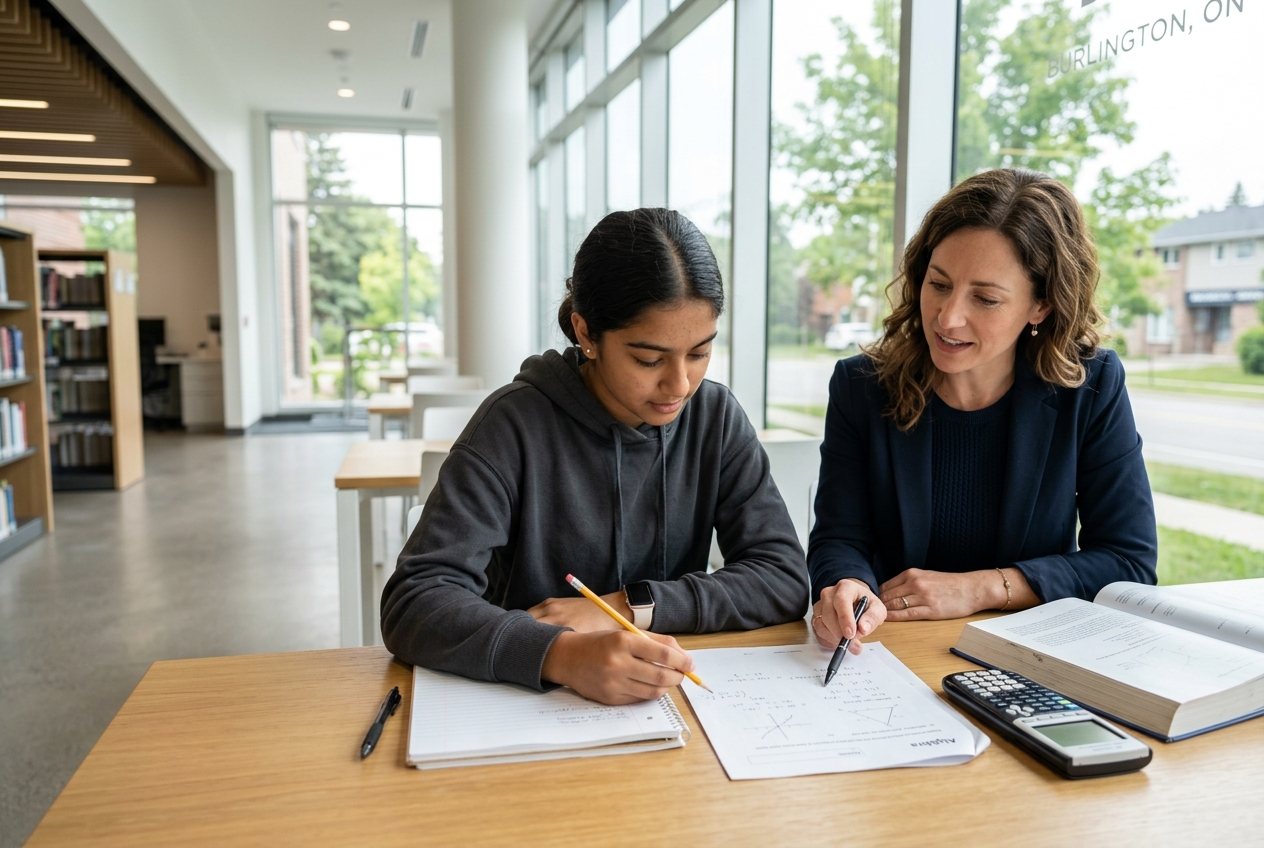
- Choose 1-on-1 Tutoring if: Your child is in Grades 7 to 12, struggles with word problems, experiences test anxiety on school exams, needs help with current homework, or is targeting competitive university STEM programs.
Need Real Help with Ontario High School Math?
Book a complimentary 60-minute diagnostic assessment. We identify prerequisite skill gaps and build a personalized roadmap tailored to your child's current school syllabus—with zero long-term contracts.
Book Your Free Diagnostic Assessment